Introduction
The most common SEO mistake is prioritising search volume over search intent. A keyword attracting 50,000 monthly searches means nothing if the searchers are students researching a topic for homework — not buyers ready to invest in your service. Keyword intent mapping solves this problem by aligning every piece of content you create with the commercial reality of what your target customer is seeking at each stage of their buying journey.
This guide provides a practical, implementable framework for identifying, categorising, and systematically targeting the high-commercial-intent keywords that generate qualified leads, not just traffic metrics.
What is keyword intent mapping? Keyword intent mapping is the process of categorising your target keywords by searcher intent (informational, navigational, commercial, or transactional) and matching each keyword to the most appropriate content type and page on your website — maximising both ranking probability and conversion rate.
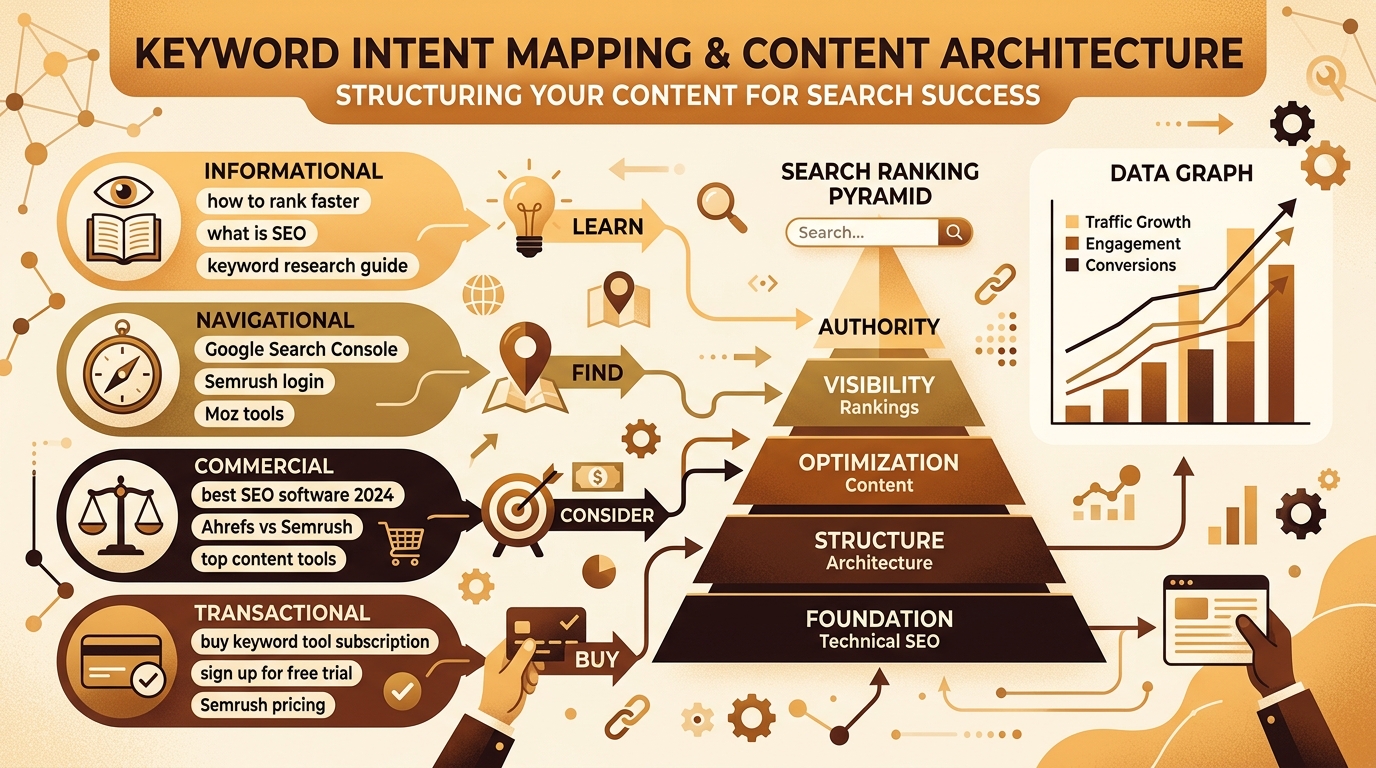
The 4 Types of Search Intent
Every search query falls into one of four primary intent categories. Understanding these is the foundation of keyword strategy:
Informational Intent
The searcher wants to learn something. Examples: "what is technical SEO", "how does GA4 work", "SEO vs PPC difference". These queries deserve educational blog posts and guides. Conversion probability is low but brand awareness and E-E-A-T building is high.
Navigational Intent
The searcher is looking for a specific brand or website. Examples: "Haridev SD portfolio", "Google Search Console login". Target these with branded pages and ensure your brand name ranks in position 1. These rarely need content creation investment.
Commercial Investigation Intent
The searcher is comparing options before buying. Examples: "best SEO consultant Kerala reviews", "top digital marketing agencies Trivandrum", "Ahrefs vs SEMrush comparison". Target with comparison pages, case studies, and testimonial-rich service pages.
Transactional Intent
The searcher is ready to take action — hire, buy, or book. Examples: "hire SEO specialist Kerala", "technical SEO audit service", "digital marketing consultant contact". These are your highest-priority keywords. Target with optimised service landing pages with clear CTAs.
Identifying Commercial & Transactional Keywords
Commercial and transactional keywords consistently share identifiable linguistic patterns. Train yourself to spot these high-value intent signals:
Commercial Investigation Modifiers
- Comparison: "vs", "compared to", "alternative to", "or"
- Evaluation: "best", "top", "review", "reviews", "rating", "recommended"
- Research: "cost of", "price of", "how much does", "affordable"
Transactional Intent Modifiers
- Action verbs: "hire", "get", "buy", "order", "book", "schedule", "contact"
- Service qualifiers: "agency", "consultant", "service", "specialist", "expert", "freelancer"
- Location qualifiers: "near me", city name + service (e.g., "SEO consultant Trivandrum")
Content Mapping by Intent
The correct content format for each keyword is determined by its intent category. Mismatching intent to content type is one of the primary reasons pages fail to rank despite strong content quality:
| Intent Type | Best Content Format | Primary Goal |
|---|---|---|
| Informational | Blog posts, Guides, FAQs, Tutorials | Brand awareness & E-E-A-T building |
| Navigational | Homepage, About page, Brand pages | Brand protection & direct access |
| Commercial Investigation | Comparison pages, Case studies, Testimonials | Consideration & trust building |
| Transactional | Service pages, Landing pages, Contact page | Direct conversion & lead generation |
Keyword Clustering Strategy
Keyword clustering is the practice of grouping semantically related keywords and targeting them within a single, comprehensive page — rather than creating a separate page for each keyword. This approach avoids keyword cannibalisation and builds topical authority more efficiently.
How to Build a Keyword Cluster
- Identify the primary keyword — the highest commercial intent, highest search volume term for a topic. This becomes the page's primary target.
- Find semantic variants using Ahrefs "Also rank for", Google's "People also ask", and autocomplete suggestions.
- Group by SERP similarity — if two keywords return the same top 10 results in Google, they share intent and should be targeted on the same page.
- Map cluster to content — create one comprehensive page that naturally addresses the primary keyword and its semantic variants.
Build a topic cluster model: create one comprehensive "pillar page" targeting a broad commercial keyword (e.g., "SEO services Kerala") and surround it with supporting blog posts targeting specific informational queries (e.g., "what does an SEO audit include"). Internal link each supporting article back to the pillar page to concentrate topical authority and strengthen the entire cluster's rankings.
Common Intent Mapping Mistakes to Avoid
Selecting keywords purely by monthly search volume without considering buyer qualification or intent results in massive organic traffic with zero commercial value.
Writing a sales-focused service page for an informational keyword (e.g., "what is SEO") generates high bounce rates because users want education, not a pitch.
Multiple pages targeting the same keyword compete against each other, splitting authority and preventing either from ranking as well as one consolidated page could.
site:yoursite.com "target keyword". Merge or canonicalise competing pages.Long-tail commercial keywords like "affordable SEO consultant for small business Kerala" have lower volume but dramatically higher conversion rates and lower competition.
Frequently Asked Questions
Keyword intent mapping is the process of categorising target keywords by the underlying motivation of the searcher — informational, navigational, commercial investigation, or transactional — and then aligning specific content formats and page types to each intent category to maximise both ranking probability and conversion rate.
Commercial intent keywords typically contain modifiers like "best", "vs", "review", "price", "cost", "hire", "agency", or "consultant". Use tools like Ahrefs Keyword Explorer or SEMrush filtered by high CPC value — keywords with high cost-per-click in paid search have proven commercial buyer intent behind them.
No. Search intent alignment and buyer qualification are significantly more important than raw search volume. A keyword like "hire SEO consultant Kerala" may generate only 50 searches per month, but each searcher has strong purchase intent — making it worth far more than a generic 10,000-volume informational keyword with zero commercial value.
One primary keyword plus 5–15 closely related semantic variants per page is the recommended approach. Using keyword clustering, a single comprehensive page can rank for dozens of related queries without keyword stuffing — simply by thoroughly covering the topic from all relevant angles.
Conclusion
The shift from volume-based keyword selection to intent-based keyword mapping is the single most impactful change most businesses can make to their SEO strategy. By systematically targeting the commercial and transactional queries your qualified buyers actually use, you attract higher-quality traffic that converts at dramatically higher rates.
Start by auditing your existing content against the four intent categories. Identify which pages are mismatched to their target keywords, update them to match the correct format, and build new pages specifically targeting the commercial investigation and transactional queries you are currently missing. The result is organic traffic that generates genuine business revenue.